Introduction
Payroll in the education sector presents unique challenges for payroll and HR teams due to the nature of school operations. Unlike other industries, schools must navigate employment arrangements shaped by academic calendars, varied term-time definitions, stretch pay models, and staff who often hold multiple roles.
These complexities are further compounded by varying types of awards, employee entitlements and payroll compliance that is both intricate and constantly evolving.
This whitepaper draws on insights from our recent Unpacking People and Payroll Challenges for Independent Schools webinar featuring contributions from Anne Haywood from AH Digital Consulting, Lauren Harchak from Cole School Experts, and Damien Lumby from Leaders Consulting, whose expertise helped shape the practical recommendations included in the whitepaper. We also invited payroll, HR and Tech leaders of Independent schools not currently utilising Aurion to participate in an interactive poll to hear about what challenges their teams face and experts unpack practical ways to help combat them.
Here’s a summary of top three key challenges and practical ways to overcome them.
Challenge #1: Managing term and non-term time payroll
The challenge
One of the main challenges payroll and HR teams for Independent schools in Australia face is juggling payroll for term and non term time. Let’s face it, unlike other industries that follow operations by calendar year with perhaps a shut down or skeleton staff period over Christmas and New Year, schools operate by the academic calendar, which creates two distinct periods: term time and non-term time.
During term time, students are in school and staff, specifically teachers and support staff, are actively working on-site. Non-term time, however, aligns with school holidays, and while some staff take time off, others like admin and leadership teams may continue working under different contracts. This split adds complexity to payroll, especially when staff join, leave, or change hours mid-year, which affects pay, leave accruals, and compliance.
From conversations with school payroll leaders, one of the biggest headaches is the lack of clarity and consistency in how non-term time is handled across contracts and systems. It often leads to overpayments or underpayments, manual fixes, and confusion among staff.
Practical ways to overcome the challenge
Adopt the right payroll model and solution for your school
Schools typically adopt one of several models to manage payroll during non-teaching periods, each with advantages and challenges, depending on how they’re communicated and implemented:
- Even Pay Model
- Term-Time Only Model
- Defined Leave Model
Many payroll systems currently used in the Australian education sector were not purpose-built for the unique requirements of school environments. Lauren Harchak, Head of Payroll for Cole School Experts, believes that there are risks involved with manual calculations using spreadsheets. Instead, schools should consider payroll solutions that are purpose-built for schools to assist with automated calculations for term and non term payroll.
Communication is critical
Even the most advanced systems can cause confusion if employees don’t understand how their pay is calculated, especially during onboarding when new starters may be unfamiliar with term-based or averaged pay structures.
Office staff can be caught off guard by pro-rata adjustments or delayed start dates that affect their take-home pay. That’s why early conversations, detailed documentation, and close collaboration between payroll, HR, and hiring managers are essential. Clear communication during onboarding isn’t just helpful, it’s a critical factor in successfully managing term and non-term pay.
Schools can implement all or a combination of the following best practice communications:
- Early-stage communications ie. Candidate interviews and contract negotiations
- Clear offer letters
- Onboarding information and support
- Clarity of messaging and alignment between recruitment, HR and payroll teams
Challenge #2: Understanding stretch pay calculations and average pay models
The challenge
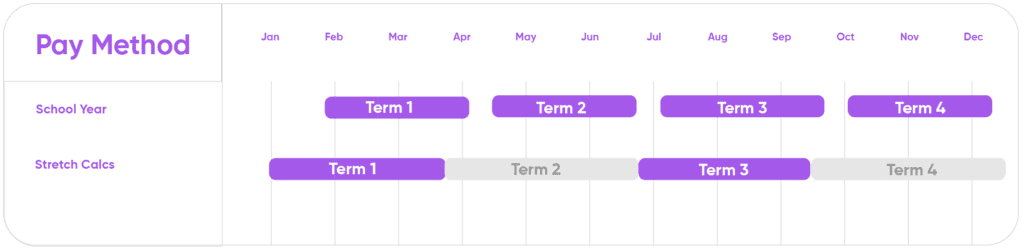
Stretch pay, also known as annualised or averaged pay, is a key payroll strategy in schools that ensures employees who don’t work year-round still receive a consistent income by spreading their total salary evenly across the full school service year.
Stretch pay takes the employee’s total annual earnings based on their actual working weeks and spreads that figure across the full 52 weeks of the year.
Some complexities with stretch pay
- Lack of standardisation across schools
- Administrative burdens and the need for payroll teams to reconciliate
- Differing employee categories and and needs
- Payslip transparency and employee trust
- Needs to be well understood by staff
- Not all payroll systems support stretch pay
Practical ways to overcome the challenge
Adopt the right payroll model and solution for your school
To effectively manage stretch pay, schools should consider:
- Clear documentation: Maintain a central guide outlining calculation methods, worked examples, and exception handling
- Ongoing training: Upskill HR and payroll teams to ensure consistency, especially through staff turnover
- Transparent payslips: Ensure employees can understand what they’re being paid and why
- System readiness: Invest in payroll solutions that are built for education and can manage stretch pay complexities
- Early communication: Embed stretch pay explanations into recruitment and onboarding workflows
Challenge #3: Managing multiple roles and strategic data integration
The challenge
Today’s schools are dynamic workplaces, with staff often wearing more than one hat.
In schools, it’s common for staff to take on multiple roles, like a teacher who is also a librarian managing co-curricular programmes, or an administrator stepping in for relief duties. These flexible arrangements give schools agility, but they also introduce some of the most complex payroll and compliance challenges in the education sector. Managing multi-role staff isn’t just an admin task, it’s a real test of your payroll system’s flexibility, the precision of your processes, and how strategically you handle HR and payroll data. When done well, it ensures accurate pay and compliance, while also enabling smarter data integration across the school’s operations.
Complications associated with multiple roles:
- Calculating leave and entitlements becomes a challenge for HR and payroll teams
- Industrial Instruments and Compliance vary for roles
- Some payroll systems have limitations around managing multiple roles and teams have to resort to manual workarounds
Practical ways to overcome the challenge
Communication, coordination, strategic data and optimal payroll solution
According to industry experts that contributed to the Whitepaper, there are number of best practice strategies schools can implement to navigate managing payroll for multiple roles.
- Communicate with employees with multiple roles that they will receive two different payment structures
- Incorporate role information on payslips
- Ensure recruitment, HR and payroll teams are on the same page operationally about managing staff with multiple roles
- Consider a single source of truth for HR and payroll data integrated with your other business applications to support access and authority management
- Payroll technology that can effectively process multiple roles including employment records, entitlements, work patterns, and reporting
Looking ahead
Flexible employment models in schools are here to stay making it essential for schools to invest in systems that can manage multi-role complexity and integrate payroll data across operations. Doing so not only ensures payroll accuracy but also enhances efficiency, compliance, and security across your school.
To maintain compliance, it’s critical that payroll processes including entitlement calculations, are automated and handled within your payroll application to avoiding risky manual workarounds like spreadsheets.
Multi-role employment reflects how modern schools operate, and those that embrace it with fit-for-purpose technology will reduce risk, improve security through integrated identity management, and deliver a clearer, more accurate employee experience. Aurion supports this by turning complexity into strength, linking payroll precision with strategic data integration to create safer, more efficient educational environments.















 Aurion acknowledges the Traditional Owners of Country throughout Australia. We pay our respect to the Aboriginal and Torres Strait Islander cultures; and to elders past and present.