






Stretch pay in schools: How education institutions can support staff financial wellness
Understand why stretch pay in schools matters for staff wellbeing and how Aurion’s integrated payroll system makes implementation easy.
 by Aurion People & Payroll Solutions

Supporting staff wellbeing goes beyond the classroom. It also includes financial wellbeing. For many school employees on term-based contracts, managing income during unpaid breaks and transitional periods can become a challenge. That’s why stretch pay in Australian schools can make a meaningful difference, to help reduce financial stress.
By distributing annual salaries evenly across 12 months, stretch pay offers a practical solution to help teachers and support staff in Education institutions maintain financial stability all year-round. Learn how stretch pay supports financial wellbeing for school staff and how Aurion’s People and Payroll system helps education institutions manage it with accuracy and ease.
What is stretch pay in schools?
Stretch pay, also known as annualised or averaged pay is a unique but vital component of payroll management in schools. It allows institutions to provide consistent income to employees who may not work all year-round, by distributing their total salary across the full school service year.
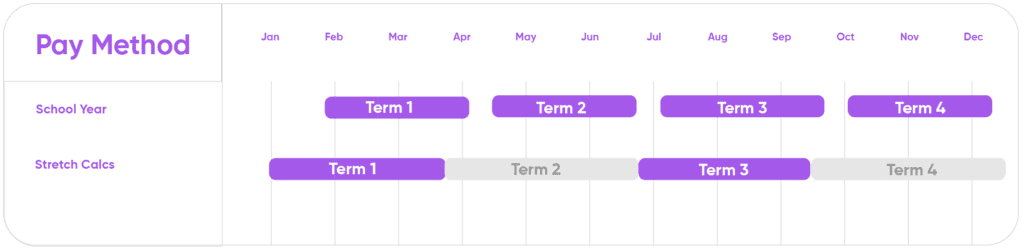
Scenario of stretch pay in schools:
For example, imagine a school employs a teacher on a 10-month contract (February to November), but offers them the option to receive their salary over 12 months instead of just the months they work.
Teacher’s income details:
- Annual salary: $90,000
- Work period: 10 months
- Stretch pay option: Paid over 12 months
- Monthly Pay: $7,500/month (instead of $9,000/month for 10 months)
How stretch pay works:
- Instead of receiving $9,000/month for 10 months, the teacher opts for stretch pay.
- The payroll system divides the $90,000 over 12 months.
- The teacher will now receive $7,500/month for 12 months, including the two months they are not actively working (December and January).
Benefits of stretch pay for school staff in Australia
Now that we’ve covered how stretch pay works, let’s take a closer look at the key benefits it offers for teachers and support staff:
- Financial stability
- Reduced financial stress
- Supports work life balance
Financial stability
By offering stretch pay over a 12-month period, schools can provide teachers and support staff with consistent income year-round. This gives staff the ability to align their pay with ongoing expenses such as rent, mortgages, and utility bills, which can help with budgeting and financial planning.
Reduced financial stress
When a teacher’s contract ends, stretch pay can provide continued income during their transition period, offering a financial cushion while they search for their next role and helping to ease the burden of uncertainty.
Supports work life balance
When income continues steadily throughout the year, staff are less likely to seek additional work during breaks, giving them the freedom to rest, recharge, or spend quality time with family and friends. This uninterrupted income stream also allows for better planning of vacations, personal development, or simply enjoying downtime without the stress of budgeting for unpaid months. By supporting financial predictability, schools help create a more balanced and sustainable work-life balance for their employees.
While stretch pay offers clear benefits, it also comes with its own complexities that schools need to be aware of and to manage with care.
Challenges of implementing stretch pay in education institutions
Stretch pay can support an employee’s financial stability and simplifies cash flow management for schools. However, beneath the surface lies a web of administrative and compliance complexities that must be managed carefully. Getting stretch pay right requires the right systems, deep knowledge of employment arrangements, and a strong focus on communication.
Let’s now explore the challenges of implementing stretch pay in schools:
- Lack of standardisation across schools
- Increased payroll complexity
- Staff misunderstanding or confusion
Lack of standardisation across schools
One of the key complexities in stretch pay is the lack of standardisation across schools. Each institution defines “term time” differently, where some operate on a 39-week model, while others on 40, 41, or even 43 weeks. Additional arrangements such as “term time plus two” further complicates matters, extending working periods while retaining the same base rate and classification. As a result, two employees on the same classification and pay rate could receive different stretch payments, depending solely on how their school defines term time.
This has implications for pay transparency, employee expectations, and recruitment. It also means stretch pay must be calculated and communicated with precision. Stretch pay arrangements must also align with relevant education awards and EBAs, which vary across Australian states and school types.
Increased payroll complexity
Stretch pay is not a “set-and-forget” process. It requires active management throughout the year particularly when employee arrangements change.
Scenarios that trigger recalculations include:
- Leave without pay
- Role changes (e.g. taking on or relinquishing a Position of Responsibility)
- Additional hours or casual work performed outside the contracted role
"Stretch pay requires vigilance. Any change in working arrangements affects the back-end calculations. You can't just set it and walk away."
- Lauren Harchak, Head of Payroll, Cole School Experts
Each of these variables affects the stretch calculation and can lead to discrepancies if not managed correctly. Often, adjustments and reconciliations must be handled outside of the payroll system in spreadsheets adding to end-of-year pressure and introducing risk.
"We had to track stretch pay changes and POR adjustments manually. It’s not scalable, and it leaves you exposed to errors."
- Lauren Harchak, Head of Payroll, Cole School Experts
Staff misunderstanding or confusion
Stretch pay only works when it is well understood. Some employees may not fully understand how stretch pay works, especially if they expect higher monthly payments during working months. New employees particularly those from outside the education sector often expect a 1:1 link between days worked and pay received.
Best practice includes
- Explaining stretch pay during the interview and onboarding
- Including worked examples in offer letters
- Providing fact sheets that outline how leave and absence affect stretch pay
- Ensuring HR and payroll deliver a consistent message
Without this, payroll teams can be overwhelmed by queries and employee dissatisfaction.
"We now explain stretch pay at the interview stage. It’s made a huge difference in setting expectations early."
- Anne Haywood, Managing Director, AH Digital Consulting
How Aurion supports stretch pay for Australian schools
Did you know that 85.7% of schools still rely on manual systems to calculate employee entitlements?
Schools that manage stretch pay effectively treat payroll not just as a back-office task, but as a strategic tool for building trust and ensuring compliance. Aurion’s payroll software is designed specifically for the Australian education sector, helping independent schools manage stretch pay with confidence.
Here is five ways Aurion can help simplify stretch pay in the Education sector:
- Configurable stretch pay models
- Automated adjustments for changes
- Transparent payslips
- End-of-Year reconciliation tools
- Onboarding and communication support
Configurable stretch pay models
Aurion allows schools to tailor stretch pay setups to different staff groups (e.g. 39, 41, or 44-week contracts), ensuring accurate and fair pay distribution across the full school year. This flexibility helps schools meet diverse employment arrangements without compromising consistency or compliance. Aurion’s system is designed to interpret and apply complex industrial instruments, including education awards and EBAs, ensuring compliance and reducing manual effort.
Automated adjustments for changes
When staff hours, roles, or leave patterns change mid-year, Aurion automatically recalculates stretch pay, eliminating manual spreadsheets and reducing errors. This ensures staff are paid correctly even when their circumstances shift, reducing payroll rework and stress.
Transparent payslips
Aurion’s payslip formats clearly show how stretch pay is calculated, helping staff understand their income and reducing confusion or disputes. Clear visibility builds trust and reduces the number of payroll-related queries from staff.
End-of-year reconciliation tools
Built-in reconciliation features simplify tracking actual hours worked and ensure accurate accruals, reducing administrative burden and audit risk. Schools can close out the year with confidence, knowing their data is accurate and audit ready.
Onboarding and communication support
Aurion provides ready-to-use templates and fact sheets to help HR teams explain stretch pay clearly during recruitment and onboarding setting expectations early. This proactive approach improves staff satisfaction and reduces misunderstandings from day one.
Stretch pay is more than a payroll feature, it’s a wellbeing strategy. With the right system in place, schools can support staff financially while simplifying operations. Learn how stretch pay supports financial wellbeing for school staff and how Aurion helps Australian schools manage it with confidence and clarity.
If your school is exploring options or navigating stretch pay complexities, contact Aurion for practical support and guidance.






 Aurion acknowledges the Traditional Owners of Country throughout Australia. We pay our respect to the Aboriginal and Torres Strait Islander cultures; and to elders past and present.